
eSIM vs Physical SIM for IoT: The Business Case Has Changed

For years, choosing a SIM card for an IoT device was a relatively straightforward hardware decision. Engineers selected a mobile network operator, inserted a SIM card, configured the modem, and deployed the product.
That approach still works. But the economics of connected devices have changed.
Today, IoT manufacturers may need to deploy thousands of devices across multiple countries, manage connectivity for a decade, and change network providers without physically accessing their equipment.
These requirements are changing the eSIM vs Physical SIM for IoT discussion.
The question is no longer simply which SIM technology costs less. It is which connectivity architecture creates fewer operational problems over the product's lifetime.
Understanding that distinction can influence hardware design, manufacturing strategy, deployment costs, security, and long-term scalability.
What Is the Difference Between eSIM and Physical SIM for IoT?
A Subscriber Identity Module, or SIM, securely stores information that allows a cellular device to authenticate with a mobile network.
In traditional IoT deployments, this information is commonly stored on a removable SIM card inserted into a device.
An embedded SIM, commonly called an eSIM, introduces a different approach.
However, an important technical distinction is often overlooked.
An eSIM is not necessarily a soldered SIM chip.
In modern IoT architecture, eSIM commonly refers to an eUICC-enabled SIM that supports remotely managing operator profiles.
An eUICC, or embedded Universal Integrated Circuit Card, is the secure component that can store and manage multiple network subscription profiles.
It may be implemented in a soldered component or a removable card.
This distinction matters because the real advantage of eSIM is not its physical size. It is the ability to manage connectivity profiles remotely.
How Traditional Physical SIM Works
A conventional physical SIM typically contains a subscription profile associated with a mobile network operator.
When the IoT device starts, its cellular modem reads the SIM credentials and attempts to register with an available network.
If the device needs a different operator subscription, changing the SIM card may be necessary.
For accessible devices deployed in a single country, this process may be entirely acceptable.
However, replacing SIM cards becomes more complicated when devices are installed inside industrial equipment, utility infrastructure, agricultural systems, or geographically distributed assets.
How IoT eSIM Works
An eSIM-enabled device uses an eUICC capable of securely receiving and managing operator subscription profiles.
Instead of replacing the physical SIM, an authorized connectivity management system can provision a compatible profile remotely.
This enables businesses to manage supported operator subscriptions without physically accessing each device.
The process still depends on compatible hardware, provisioning infrastructure, operator support, and a working communication path.
An eSIM does not automatically provide unrestricted access to every mobile network.
Why the Business Case for IoT eSIM Has Changed
The original appeal of embedded SIM technology was closely associated with smaller devices, improved physical durability, and reduced dependence on removable SIM slots.
Those benefits remain relevant.
But several developments have made remote connectivity management increasingly important.
1. IoT Deployments Are Becoming More Geographically Distributed
Consider a company manufacturing connected industrial monitoring equipment.
Its devices may be designed in Europe, manufactured in Asia, and deployed across North America, the Middle East, and Africa.
A traditional approach may require different SIM inventories for different markets.
This creates additional manufacturing and logistics work.
Teams may need to manage regional SIM variants, coordinate operator activation, and verify connectivity before shipping.
With an appropriate eSIM architecture, a manufacturer can potentially use a common hardware configuration and provision supported regional operator profiles closer to deployment.
This does not eliminate country-specific regulatory or commercial requirements.
However, it can reduce the need to physically manage multiple SIM variants.
2. Devices Are Expected to Remain Operational for Years
Industrial IoT products often have much longer service lives than consumer electronics.
A connected meter, tracking device, or industrial gateway may remain installed for many years.
During that period, network conditions and commercial arrangements can change.
An operator may alter pricing, discontinue a service, change roaming agreements, or retire a supported network technology.
A conventional SIM may require physical replacement if the existing subscription becomes unsuitable.
An eSIM architecture can offer more flexibility when an alternative compatible profile and connectivity path are available.
Importantly, eSIM cannot solve every network retirement problem.
If a device supports only a cellular radio technology that is being discontinued, changing its SIM profile will not upgrade the modem.
3. Physical Maintenance Has Become a Significant Cost
The purchase price of a SIM card is only one component of connectivity cost.
For deployed IoT products, businesses must also consider installation, field maintenance, troubleshooting, logistics, and downtime.
Imagine 5,000 connected devices installed across multiple regions.
If an operator change requires physical SIM replacement, the business must coordinate access to thousands of devices.
Even when each replacement takes only a few minutes, travel and scheduling can dominate the actual maintenance effort.
Remote provisioning can reduce this burden for supported scenarios.
4. Connectivity Flexibility Has Become a Business Requirement
A company may launch an IoT product using one operator and later discover that another provider offers better coverage or commercial terms in a particular market.
With conventional SIM arrangements, changing subscriptions can be operationally difficult.
An eSIM strategy can make operator changes more practical.
However, the ability to switch depends on the eUICC platform, available operator profiles, commercial agreements, and provisioning system.
The business value comes from having a practical migration option, not from assuming every operator switch will be automatic.
How eSIM Works in an IoT Architecture
To understand the benefits of eSIM, it helps to examine the components involved.
A typical cellular IoT system contains several layers.
The IoT Device
The device contains sensors, a processor or microcontroller, a cellular modem, and a SIM or eUICC.
The modem provides access to cellular networks such as LTE-M, NB-IoT, LTE, or 5G, depending on hardware and network support.
The SIM component securely stores the credentials used for network authentication.
The Cellular Network
The mobile network operator provides connectivity between the device and its destination systems.
Depending on the application, data may travel to a cloud platform, enterprise server, or specialized IoT backend.
The Connectivity Management Platform
A connectivity management platform helps organizations monitor subscriptions, data consumption, activation status, and network usage.
When integrated with compatible eSIM provisioning systems, it may also support remote profile management.
The Remote SIM Provisioning Infrastructure
Remote SIM Provisioning, or RSP, enables supported eUICCs to receive and manage operator profiles securely.
Different generations of eSIM specifications use different provisioning architectures.
This distinction is especially important for IoT products.
GSMA SGP.32: Why It Matters for IoT eSIM
One of the most significant developments in IoT connectivity is the GSMA SGP.32 specification.
Earlier eSIM architectures were designed primarily around machine-to-machine systems or consumer devices.
Traditional M2M remote provisioning architectures can involve complex relationships between subscription management systems.
Consumer eSIM provisioning typically assumes that a user can interact with a device to download and activate a profile.
Many IoT products cannot rely on either approach.
A water meter installed underground may not have a screen.
An industrial sensor may have limited memory and processing capacity.
A tracking device may operate remotely without anyone available to approve connectivity changes.
SGP.32 addresses these types of IoT requirements through an architecture designed for constrained and remotely managed devices.
Important Components of SGP.32
eUICC
The secure component that stores and manages subscription profiles.
eIM — eSIM IoT Remote Manager
A management component that coordinates remote profile management operations for IoT devices.
IPA — IoT Profile Assistant
A component that assists with profile-related operations and communication between the device environment and provisioning infrastructure.
Depending on the implementation, the IPA may operate on the device or within the eUICC.
SM-DP+ — Subscription Manager Data Preparation+
The system responsible for securely preparing and delivering operator profiles.
Together, these components support remote provisioning workflows designed for IoT environments.
The specification is important because it provides a standardized architecture for managing eSIM profiles in devices that may have limited user interfaces and constrained resources.
However, specification availability does not mean every modem, eUICC, operator, or platform supports SGP.32.
Compatibility must be verified across the complete solution.
For technical reference, consult the GSMA official website and its eSIM specifications.
Planning an IoT product that may operate across multiple countries or network providers? Infolitz Software Pvt. Ltd. can help evaluate cellular connectivity requirements, embedded hardware compatibility, and lifecycle management before architecture decisions become expensive to change.
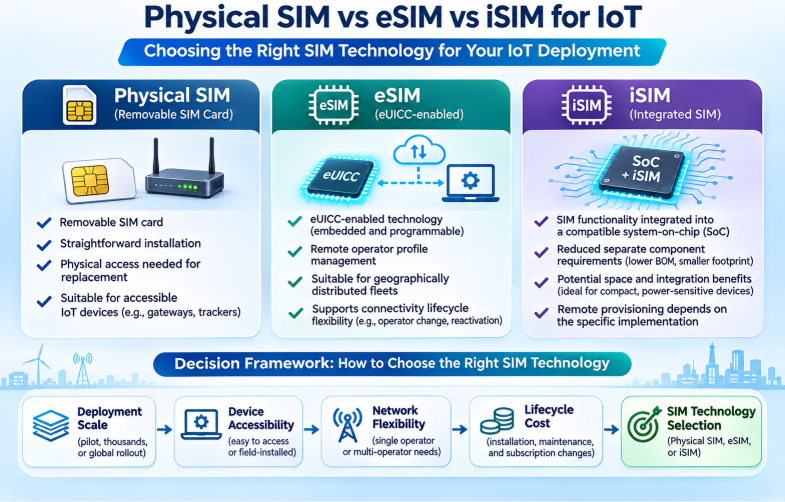
Physical SIM, eSIM, and iSIM: Understanding the Options
IoT connectivity decisions increasingly involve three terms: physical SIM, eSIM, and iSIM.
Although related, they describe different aspects of SIM implementation.
Traditional Removable SIM
A conventional removable SIM uses a physical card installed in a socket.
Its main advantages are familiarity, broad compatibility, and straightforward replacement when the device is accessible.
Its limitations become more visible when devices are sealed, remotely installed, or deployed in large fleets.
eSIM with eUICC
An eSIM implementation supports remote subscription profile management.
The eUICC may be soldered onto the circuit board or provided in a removable form factor.
This flexibility can simplify subscription changes and reduce the need for physical access.
However, it introduces provisioning infrastructure and compatibility requirements.
Integrated SIM or iSIM
An integrated SIM, or iSIM, incorporates SIM functionality into a secure environment within a compatible system-on-chip.
This approach can reduce the need for a separate SIM component.
It may also offer advantages for compact, power-sensitive devices.
However, iSIM is not automatically equivalent to remote provisioning.
The supported subscription management capabilities depend on the specific implementation.
Which Option Makes Sense?
A conventional removable SIM may be appropriate for a small deployment where devices are easy to access.
An eUICC-based solution becomes more attractive when remote subscription management is important.
An iSIM implementation may be worth evaluating when component integration, board space, and power requirements are major design considerations.
The correct choice depends on the complete product architecture rather than the SIM technology alone.
Tools and Technology Stack for IoT eSIM Deployment
Implementing eSIM requires more than selecting an appropriate SIM component.
The device hardware, modem firmware, connectivity provider, provisioning infrastructure, and cloud application must work together.
Cellular Modems
The modem must support the intended radio technologies, frequency bands, and SIM interface requirements.
Engineers should verify compatibility with the selected eUICC and provisioning approach.
A modem supporting LTE-M or NB-IoT does not necessarily support every eSIM provisioning workflow.
eUICC Components
The eUICC must support the intended profile management architecture.
Teams should evaluate supported specifications, security certifications where applicable, environmental ratings, and component lifecycle availability.
Connectivity Providers
Connectivity providers supply network access and subscription management services.
Some offer regional coverage, while others provide international IoT connectivity arrangements.
Coverage claims should be checked against actual deployment locations, radio technologies, roaming restrictions, and operator agreements.
Provisioning Platforms
The provisioning platform manages the secure delivery and lifecycle of operator profiles.
For an SGP.32-based architecture, compatibility between the eIM, IPA, eUICC, and profile delivery infrastructure is essential.
Device Management and Cloud Platforms
The cloud platform may track device identity, subscription status, connectivity events, and operational health.
However, the application must distinguish between device availability and SIM profile state.
A successful profile download does not necessarily mean the device has established reliable application connectivity.
Recommended Selection Approach
Start with the deployment requirements rather than a preferred vendor.
Identify target countries, expected device lifetime, supported cellular networks, power constraints, and connectivity recovery requirements.
Then validate the complete solution through hardware testing and field trials.
Best Practices for Choosing eSIM for IoT
eSIM can simplify long-term connectivity management, but only when the implementation is designed carefully.
The following practices reduce avoidable deployment risks.
1. Define the Device Lifecycle
Estimate how long the device will remain operational.
Consider whether the product will need to survive operator changes, ownership transfers, international relocation, or changes in connectivity contracts.
A product designed for a two-year pilot may have very different requirements from a utility meter expected to remain installed for more than a decade.
2. Verify Network Compatibility
Confirm the supported radio technologies and frequency bands.
An eSIM cannot compensate for missing modem capabilities.
For example, switching operator profiles will not enable LTE-M connectivity on a modem that does not support LTE-M.
3. Test Remote Provisioning Before Deployment
Do not assume that successful laboratory provisioning guarantees reliable field operation.
Test profile downloads, activation, switching, and recovery under realistic network conditions.
Include scenarios involving weak signal strength, interrupted downloads, and temporary connectivity loss.
4. Plan for Connectivity Recovery
Remote provisioning introduces an important dependency.
The device needs an appropriate communication path to receive provisioning instructions and profile data.
If the existing connection becomes unavailable, switching to another profile may be difficult unless a suitable recovery mechanism has been designed.
Possible approaches include a bootstrap subscription, an already installed fallback profile, or another supported communication channel.
The exact options depend on the eUICC architecture and commercial arrangements.
5. Protect Device and Subscription Identity
Device identity and SIM subscription identity serve different purposes.
The SIM authenticates the device to the cellular network.
The application may separately authenticate the device to the cloud platform using certificates, cryptographic keys, or other credentials.
Changing an operator profile should not unintentionally break application-level identity or authorization.
6. Validate International Deployment Rules
Global connectivity is not simply a matter of selecting a provider with international coverage.
Some countries restrict permanent roaming or impose local connectivity requirements.
Businesses must verify applicable regulations, operator policies, and commercial arrangements for each deployment market.
7. Measure Operational Outcomes
Track the metrics that determine whether eSIM is creating value.
Useful measures include provisioning success rate, activation time, failed profile changes, field maintenance visits, connectivity downtime, and subscription management costs.
Performance, Cost, and Security Considerations
The strongest argument for eSIM is often operational flexibility.
However, businesses should evaluate performance, cost, and security separately.
Does eSIM Improve IoT Network Performance?
Not inherently.
An eSIM does not automatically improve cellular signal strength, modem sensitivity, throughput, or latency.
Those characteristics depend primarily on the modem, antenna design, network technology, radio conditions, and operator infrastructure.
An eSIM can indirectly improve connectivity outcomes when it enables a device to use a more suitable available operator profile.
For example, a company may discover that one operator provides unreliable coverage at a particular industrial location.
If the device and provisioning architecture support switching to another suitable operator, eSIM can help address that problem without replacing the SIM physically.
However, network improvement is conditional, not guaranteed.
Is eSIM More Expensive Than Physical SIM?
The answer depends on whether the comparison considers hardware cost or total cost of ownership.
A conventional SIM may have a lower initial component and provisioning cost.
An eSIM solution may introduce additional expenses for eUICC components, provisioning services, connectivity management, integration, and testing.
However, those costs should be evaluated against potential savings from reduced physical maintenance, simpler logistics, and more flexible subscription management.
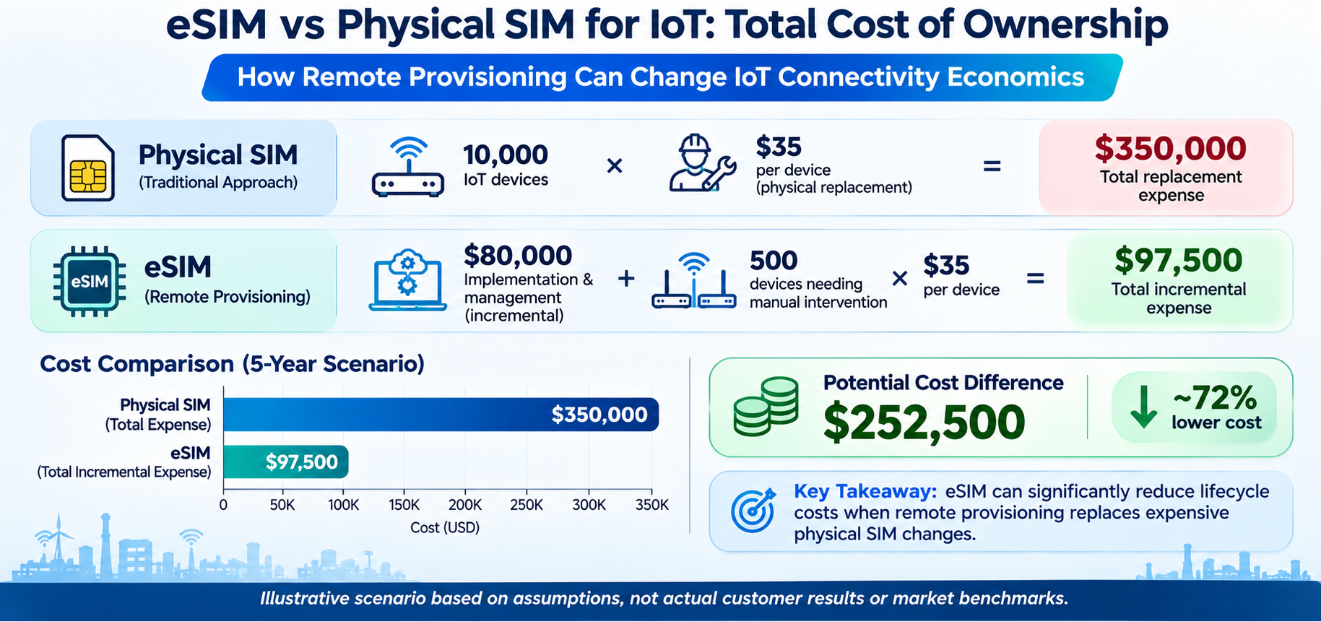
An Illustrative IoT Connectivity Cost Scenario
Consider a business operating 10,000 connected devices over five years.
Assume the company anticipates one operator migration during that period.
Under a traditional SIM model, the migration may require physical access to devices.
Suppose the average incremental cost of visiting and replacing a SIM is $35 per device.
The estimated replacement expense would be:
10,000 devices × $35 = $350,000
Now consider an eSIM architecture.
Assume the incremental cost of eSIM hardware, provisioning infrastructure, and management services over the five-year period averages $8 per device.
The estimated incremental eSIM expense would be:
10,000 devices × $8 = $80,000
If remote provisioning succeeds for 95% of devices, 500 devices may still require manual intervention.
At an illustrative $35 per visit, that adds:
500 devices × $35 = $17,500
The combined incremental expense would be approximately:
$80,000 + $17,500 = $97,500
Under these assumptions, the eSIM approach could avoid approximately $252,500 in migration-related costs.
These figures are hypothetical and are not market benchmarks or actual customer results.
They exclude common connectivity charges and assume one migration event. Actual economics depend on negotiated pricing, operational conditions, provisioning success, and the likelihood of needing to change subscriptions.
The calculation illustrates an important principle.
The business case for eSIM becomes stronger when avoiding physical intervention has meaningful value.
If a company never needs to change operators and its devices are easily accessible, the financial advantage may be much smaller.
Is eSIM More Secure?
Both conventional SIM and eUICC technologies use secure mechanisms to protect network authentication credentials.
An eSIM architecture can provide additional operational security benefits.
For example, a soldered eUICC can reduce casual physical removal compared with an accessible removable SIM.
Remote provisioning can also support controlled subscription lifecycle management.
However, eSIM is not automatically more secure in every implementation.
The provisioning infrastructure, management interfaces, credentials, and device software introduce their own security requirements.
Organizations should evaluate secure profile delivery, authentication, access controls, audit logging, and recovery procedures.
A compromised management account or poorly protected provisioning interface can create operational risk.
What About Power Consumption?
An eSIM does not automatically reduce the energy consumed by cellular communication.
Power consumption is influenced primarily by modem behavior, network conditions, data transmission patterns, and device sleep strategies.
For battery-powered devices, engineers should test the complete system.
This includes any additional communication required during provisioning and profile management.
Evaluating cellular IoT hardware or planning a large deployment? Infolitz can support embedded design reviews, connectivity integration, cloud architecture, and deployment-readiness testing to help identify technical and operational risks early.
Real-World IoT Use Cases Where eSIM Can Create Value
The value of eSIM varies significantly by application.
Some deployments benefit primarily from remote provisioning.
Others benefit from manufacturing flexibility, physical durability, or subscription lifecycle management.
Industrial Equipment Monitoring
Industrial monitoring devices are often installed inside machines, electrical cabinets, or remote facilities.
Physical access may require scheduled maintenance or coordination with site operators.
An eSIM architecture can reduce the need to open equipment when changing supported network subscriptions.
This can be valuable for long-lived industrial monitoring systems.
Smart Metering
Utility meters may remain installed for many years.
Replacing SIM cards across a large meter fleet can be operationally expensive.
Remote subscription management can provide flexibility when operator contracts or network arrangements change.
However, low-power communication behavior and recovery mechanisms must be carefully validated.
Fleet Tracking and Logistics
Tracking devices frequently cross regional or national boundaries.
A connectivity strategy based on compatible eSIM profiles can help organizations manage regional subscription requirements.
Nevertheless, cross-border connectivity remains subject to operator coverage, roaming agreements, and local regulations.
Agricultural IoT
Agricultural sensors and monitoring gateways may operate in remote locations.
Accessing devices can require travel across large farms or difficult terrain.
Where supported, remote subscription management can reduce maintenance visits.
However, eSIM cannot overcome the absence of suitable cellular coverage.
Connected Medical Equipment
Connected medical devices may require reliable communication, controlled configuration, and documented lifecycle management.
An eSIM strategy can support subscription flexibility, but changes must be evaluated against applicable regulatory, cybersecurity, and validation requirements.
Connectivity modifications should not bypass established product change-control processes.
Mini Case Study: Evaluating eSIM for a Global IoT Product
Consider a hypothetical manufacturer of industrial environmental monitoring devices.
The company plans to deploy 20,000 devices across several countries.
Its original product design uses removable SIM cards.
Each regional deployment requires coordination with a local connectivity provider.
The manufacturing team maintains multiple SIM inventories, while field technicians occasionally replace SIM cards when devices move between operators.
The Challenge
The manufacturer wants to simplify production and reduce dependence on physical subscription changes.
However, it cannot compromise connectivity reliability or introduce excessive provisioning complexity.
The Proposed Approach
The engineering team evaluates an eUICC-based design with remote provisioning support.
The architecture includes a compatible cellular modem, secure eUICC, provisioning infrastructure, and cloud-based connectivity monitoring.
Before rollout, the team tests operator profile changes, interrupted provisioning, network recovery, and regional connectivity behavior.
The Potential Outcome
A successful implementation could allow the manufacturer to reduce regional SIM inventory complexity and manage supported subscription changes remotely.
It could also reduce field visits associated with operator migration.
However, these outcomes would need to be validated through pilot deployment data.
This example is illustrative, not a documented Infolitz customer engagement.
The lesson is that eSIM should be evaluated as part of the complete connected-product lifecycle, rather than as an isolated component replacement.
eSIM vs Physical SIM for IoT: Which Should You Choose?
There is no universal answer.
The appropriate technology depends on deployment scale, device accessibility, geographic distribution, expected lifetime, and connectivity management requirements.
Choose Conventional Physical SIM When
A conventional removable SIM may be sufficient when devices are deployed in one region, use a stable operator arrangement, and remain easy to access.
It may also be appropriate for prototypes, short-term pilots, and cost-sensitive applications where remote subscription management provides limited value.
The simpler provisioning model can reduce initial implementation effort.
Consider eSIM When
eSIM becomes attractive when devices are deployed across multiple regions or expected to operate for many years.
It is particularly relevant when physical SIM replacement is expensive, operator flexibility is important, or manufacturing teams want to reduce subscription-specific hardware configurations.
The business case strengthens when connectivity changes are likely during the device lifecycle.
Consider iSIM When
iSIM may be relevant for compact or highly integrated products where component count, board space, and power efficiency are important.
However, engineers must verify the supported subscription management capabilities and available hardware ecosystem.
The Most Important Decision Factors
Before selecting a SIM architecture, answer five questions.
- How many devices will be deployed, and where?
- How expensive would physical access be after installation?
- How likely are operator or subscription changes?
- What provisioning and recovery capabilities are supported?
- What is the total cost over the expected device lifetime?
These questions often reveal more than a comparison of SIM component prices.
Common Mistakes When Adopting IoT eSIM
Mistake 1: Assuming eSIM Means Automatic Network Switching
An eSIM can support multiple operator profiles, but automatic switching requires additional capabilities, policies, and compatible infrastructure.
It should not be confused with seamless roaming or continuous multi-network connectivity.
Mistake 2: Ignoring Modem Compatibility
The modem must support the intended cellular networks and work with the selected provisioning architecture.
A compatible eUICC alone is insufficient.
Mistake 3: Treating eSIM as a Guaranteed Cost Reduction
Remote provisioning may reduce operational expenses, but implementation and recurring management costs must be considered.
For small or static deployments, conventional SIM can remain economical.
Mistake 4: Failing to Plan Recovery
If a device loses connectivity during a profile transition, remote recovery may become difficult.
Fallback profiles and recovery procedures should be designed and tested before large-scale deployment.
Mistake 5: Overlooking Ownership and Portability
Organizations should understand who controls the eUICC management environment, operator profiles, and provisioning credentials.
Contractual and technical restrictions may affect the ability to migrate between connectivity providers.
Mistake 6: Assuming Every eSIM Platform Supports SGP.32
Different eSIM implementations may support different provisioning specifications.
SGP.32 compatibility must be confirmed across the eUICC, device software, management platform, and service provider.
FAQs
1. What is the main difference between eSIM and physical SIM for IoT?
A conventional physical SIM generally requires physical replacement to change its operator subscription.
An eSIM with eUICC functionality can support remote subscription profile management.
The primary difference is subscription flexibility, not necessarily the physical form factor.
2. Is eSIM better than physical SIM for IoT devices?
eSIM can be advantageous for geographically distributed, remotely installed, or long-lived IoT devices.
However, conventional SIM may remain simpler and more economical for small deployments with stable connectivity requirements.
The best choice depends on lifecycle costs and operational needs.
3. How does eSIM work in IoT?
An eSIM uses an eUICC to securely store and manage cellular operator profiles.
Compatible remote provisioning infrastructure can download and manage supported profiles without physically replacing the SIM.
4. Is eSIM more expensive than a physical SIM?
Initial eSIM hardware and provisioning costs may be higher.
However, remote subscription management can reduce expenses associated with SIM replacement, field visits, and regional inventory management.
Total cost of ownership provides a more meaningful comparison than component price alone.
5. Can an IoT eSIM switch between network operators?
Yes, when the device, eUICC, provisioning platform, and operator arrangements support the change.
Switching is not universally available across all operators or devices.
6. What is GSMA SGP.32?
SGP.32 is a GSMA technical specification defining a remote SIM provisioning architecture for IoT devices.
It supports managing eSIM profiles in environments where devices may have limited interfaces, processing resources, or direct user interaction.
7. Is eSIM more secure than physical SIM?
Both technologies use secure SIM mechanisms for network authentication.
eSIM can offer benefits such as reduced physical accessibility and controlled remote profile management.
However, overall security depends on the complete device, provisioning, and management architecture.
8. What is the difference between eSIM and iSIM?
eSIM generally refers to remote-manageable SIM functionality using an eUICC.
iSIM integrates SIM functionality into a secure environment within a compatible system-on-chip.
The terms describe different characteristics and are not mutually exclusive in every implementation.
9. Can existing IoT devices migrate from physical SIM to eSIM?
Some devices may support migration through a compatible removable eUICC solution.
Others may require firmware changes, modem compatibility validation, or hardware redesign.
Migration feasibility depends on the existing device architecture and the intended provisioning system.
10. Does eSIM improve cellular coverage?
Not directly.
eSIM does not improve antenna performance or radio sensitivity.
It may provide greater flexibility to use a different supported operator profile when that operator offers more suitable coverage.
The real value of IoT eSIM is not eliminating the SIM card. It is eliminating the need to physically access thousands of devices just to change how they connect.

Conclusion
The eSIM vs Physical SIM for IoT decision has evolved from a component-level comparison into a broader question of deployment efficiency, connectivity flexibility, and long-term operating cost.
Physical SIM remains suitable for many applications. eSIM becomes increasingly valuable when devices are difficult to access, operate across multiple markets, or need subscription flexibility over many years.
Planning a connected product or reviewing your existing IoT connectivity architecture? Contact Infolitz Software Pvt. Ltd. to discuss embedded hardware, cellular integration, cloud connectivity, and the engineering decisions that can affect your product throughout its lifecycle.


