

Private 5G vs Wi-Fi 7: Which Is Right for Industrial IoT?

Industrial connectivity is entering a new phase. Factories, warehouses, logistics hubs, and energy facilities increasingly depend on wireless networks to connect machines, sensors, robots, and operational systems.
Two technologies are attracting significant attention: private 5G and Wi-Fi 7.
Both promise faster communication, improved reliability, and support for demanding industrial applications. However, their underlying architectures, deployment requirements, and operational characteristics differ considerably.
For industrial decision-makers, the challenge is not identifying which technology offers the highest advertised speed. It is determining which network can reliably support real operational workloads.
This guide compares Private 5G vs Wi-Fi 7 across performance, coverage, security, cost, mobility, and industrial use cases to help organizations make informed connectivity decisions.
Why Industrial Organizations Are Considering Private 5G
Traditional industrial networks often rely on wired Ethernet, industrial fieldbus systems, and Wi-Fi.
These technologies remain essential, but some industrial environments increasingly require reliable connectivity for moving equipment.
Consider a large manufacturing facility operating autonomous mobile robots.
The robots travel between production lines, storage areas, and loading bays. They continuously exchange information with fleet management systems and other operational applications.
As robots move, their wireless connections must remain available.
Private 5G can address this requirement through cellular mobility management, controlled radio resources, and network designs optimized for the facility.
Its potential advantages include:
Wide-area coverage: A properly engineered private 5G network can cover large industrial facilities with fewer radio sites than some Wi-Fi designs, depending on spectrum, building layout, and capacity requirements.
Managed mobility: Cellular networks are designed to support devices moving between coverage areas.
Traffic prioritization: 5G supports quality-of-service mechanisms that help operators allocate network resources according to application requirements.
Controlled access: SIM-based authentication and dedicated network infrastructure provide mechanisms for managing authorized devices.
Operational integration: Local 5G core deployments can keep selected industrial traffic within the facility.
However, these capabilities come with additional infrastructure, spectrum, integration, and management considerations.
Private 5G is not automatically the best solution for every industrial environment.
What Is Wi-Fi 7, and How Does It Work?
Wi-Fi 7 is the latest major generation of Wi-Fi technology, based on the IEEE 802.11be standard.
It is designed to improve wireless throughput, efficiency, and performance in environments where many devices compete for network resources.
Wi-Fi 7 introduces several important capabilities.
Multi-Link Operation
Multi-Link Operation, commonly called MLO, allows compatible devices to use multiple wireless links.
Depending on device capabilities and configuration, these links can improve throughput, resilience, or latency behavior.
For example, a Wi-Fi 7 device may operate across supported 5 GHz and 6 GHz links rather than depending on a single connection.
This can help improve performance when one link experiences congestion.
However, MLO behavior depends on the capabilities of both the access point and the connected device.
Wider Wireless Channels
Wi-Fi 7 supports channels up to 320 MHz in the 6 GHz band where regulations permit.
Wider channels can deliver higher throughput when sufficient spectrum is available.
This is useful for applications such as:
- High-resolution industrial video.
- Large engineering file transfers.
- Augmented reality maintenance tools.
- Machine vision data transmission.
- High-density enterprise connectivity.
Not every country permits the same 6 GHz spectrum usage, and not every Wi-Fi 7 device supports the maximum channel width.
4K-QAM Modulation
Wi-Fi 7 introduces 4096-QAM, also known as 4K-QAM.
This modulation technique can carry more information per transmitted symbol than the 1024-QAM used in Wi-Fi 6.
Under favorable radio conditions, it can improve peak data rates.
However, higher-order modulation requires strong signal quality.
In industrial environments containing metal structures, machinery, and electromagnetic interference, devices may frequently operate at lower modulation rates.
Multi-Resource Unit Support
Wi-Fi 7 improves how wireless resources can be allocated to devices.
This helps access points use available spectrum more efficiently under suitable conditions.
For industrial deployments, the practical benefit is improved flexibility when serving multiple connected devices.
Why Wi-Fi 7 Matters for Industrial Sites
Many industrial facilities already have enterprise Wi-Fi infrastructure.
Wi-Fi 7 provides a potential upgrade path without requiring organizations to adopt a completely different wireless networking model.
It can support high-bandwidth applications, mobile workstations, connected tools, cameras, and industrial applications that do not require cellular-specific mobility or coverage characteristics.
The important distinction is that Wi-Fi 7 primarily advances wireless LAN performance, while private 5G provides a cellular networking architecture with different mobility, authentication, and traffic-management capabilities.
Need to Modernize an Existing Industrial Network?
Industrial connectivity decisions should begin with application requirements rather than technology preferences.
Infolitz Software Pvt. Ltd. helps organizations evaluate connected-device architectures, industrial IoT integration, embedded systems, and cloud connectivity requirements.
A structured technical assessment can help identify whether an existing Wi-Fi network needs improvement or whether a different wireless architecture is justified.
Private 5G vs Wi-Fi 7: How Their Architectures Differ
Although both technologies provide wireless communication, they operate through different networking architectures.
Understanding this difference is essential when evaluating industrial deployments.
Private 5G Architecture
A typical private 5G industrial network follows this communication path:
Industrial Device → 5G Radio Network → Private 5G Core → Edge or Enterprise Applications
The industrial device connects through a 5G modem.
The radio network provides wireless access, while the 5G core handles functions such as authentication, session management, and traffic routing.
Applications may run on local edge servers, private cloud infrastructure, or external cloud platforms.
For latency-sensitive applications, local processing can reduce dependence on distant cloud services.
A private 5G deployment may also include:
- Industrial routers and gateways.
- Local user-plane processing.
- Network monitoring.
- Device provisioning.
- Policy-based traffic management.
- Integration with enterprise IT and operational technology systems.
The architecture is particularly relevant when organizations need centralized management of large numbers of mobile devices.
Wi-Fi 7 Architecture
A typical Wi-Fi 7 deployment follows this path:
Industrial Device → Wi-Fi 7 Access Point → LAN Infrastructure → Edge or Enterprise Applications
Devices connect through Wi-Fi 7-compatible radios.
Access points provide wireless connectivity and forward traffic into the organization's wired network.
Depending on the design, centralized controllers or cloud management platforms coordinate access point configuration and monitoring.
A Wi-Fi 7 deployment may include:
- Industrial or enterprise-grade access points.
- Network switches.
- Wireless controllers.
- Authentication infrastructure.
- VLANs and network segmentation.
- Edge computing servers.
- Monitoring and troubleshooting tools.
For organizations with established Ethernet and Wi-Fi infrastructure, this architecture may be easier to integrate into existing operations.
The Architectural Difference That Matters
Private 5G uses cellular network mechanisms for device identity, mobility, and traffic management.
Wi-Fi 7 uses wireless LAN mechanisms that can deliver excellent performance within a properly engineered local network.
Neither architecture eliminates the need for careful radio planning.
Both require appropriate coverage design, capacity planning, interference analysis, and operational monitoring.
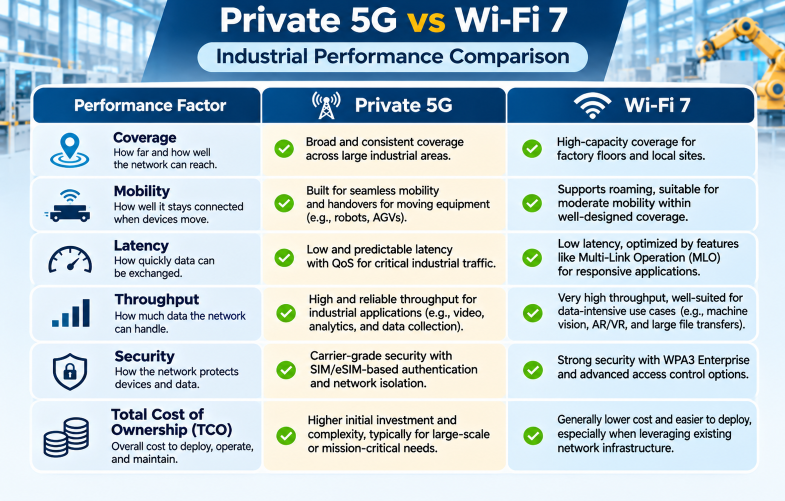
Private 5G vs Wi-Fi 7: Performance and Reliability
Performance comparisons often focus on advertised maximum speeds.
For industrial applications, this can be misleading.
A network supporting automated guided vehicles has different requirements from one connecting warehouse tablets.
Similarly, a machine vision application may require substantial bandwidth but relatively little mobility.
The correct evaluation must consider several performance characteristics.
Throughput: Which Technology Is Faster?
Wi-Fi 7 supports very high theoretical throughput.
Its maximum theoretical aggregate PHY rate is approximately 46 Gbps across supported configurations and spatial streams.
This figure represents an idealized technical maximum, not the throughput an industrial device should expect.
Actual performance depends on channel width, radio conditions, client capabilities, interference, network load, and protocol overhead.
Private 5G throughput depends on spectrum allocation, channel bandwidth, radio configuration, device capability, and deployment architecture.
In many indoor environments, Wi-Fi 7 may offer greater peak throughput for compatible devices.
However, peak throughput alone does not determine industrial suitability.
A robot receiving consistent connectivity while moving through a factory may benefit more from predictable network behavior than from exceptionally high peak speed.
Latency: Which Technology Responds Faster?
Latency is the time required for data to travel between communicating systems.
Low latency matters for applications such as:
- Industrial motion monitoring.
- Robot coordination.
- Remote equipment operation.
- Real-time video analytics.
- Automated inspection.
- Safety-related monitoring.
Both private 5G and Wi-Fi 7 can support low-latency communication under appropriate conditions.
Private 5G includes quality-of-service capabilities and cellular scheduling mechanisms that can support predictable traffic handling.
Wi-Fi 7 introduces features that can reduce contention and improve latency performance, including Multi-Link Operation.
However, neither technology guarantees a specific application latency merely because it supports a particular standard.
Actual latency depends on:
- Radio conditions.
- Network congestion.
- Device capabilities.
- Traffic prioritization.
- Application processing.
- Network architecture.
- Edge server placement.
For demanding industrial applications, engineers should measure end-to-end latency and jitter under realistic operating conditions.
A network with slightly higher average latency but fewer extreme delays may be more suitable than one with excellent average latency and unpredictable spikes.
Reliability: What Happens When Conditions Change?
Industrial facilities are difficult wireless environments.
Metal equipment, moving machinery, shelving, walls, and changing production layouts can affect radio propagation.
Private 5G can provide controlled cellular coverage and mobility management.
Wi-Fi 7 can provide high-performance local connectivity, including resilience benefits from supported multi-link configurations.
However, neither technology is immune to interference, coverage gaps, device failures, or infrastructure outages.
Reliable industrial networking requires redundancy, monitoring, and recovery planning.
Mobility: A Major Differentiator
Mobility is one of the strongest reasons to evaluate private 5G.
Cellular networks are designed to maintain communication as devices move between radio coverage areas.
Wi-Fi networks also support roaming, including through technologies such as IEEE 802.11r, 802.11k, and 802.11v.
However, roaming performance depends on client implementation, access point configuration, network design, and application behavior.
For stationary equipment, Wi-Fi 7 may be entirely sufficient.
For fast-moving industrial equipment crossing large facilities, private 5G deserves closer evaluation.
Industrial Wireless Connectivity: Tools and Technology Stack
Choosing a wireless technology also means choosing the surrounding infrastructure.
The radio connection is only one component of the overall system.
Private 5G Technology Stack
A private 5G deployment typically requires radio access equipment, core network software, compatible modems, spectrum access, and network management capabilities.
Industrial gateways may connect existing equipment to the 5G network.
For example, a machine using Modbus TCP or Ethernet-based communication may connect through a gateway equipped with a 5G modem.
The gateway provides wireless transport while the machine continues using its existing industrial protocol.
This can reduce the need to replace equipment.
However, the gateway introduces another component that must be configured, secured, powered, and maintained.
Wi-Fi 7 Technology Stack
A Wi-Fi 7 deployment typically requires compatible access points, switching infrastructure, client adapters, security configuration, and network monitoring.
Existing industrial devices may connect through Wi-Fi-enabled gateways.
For organizations already operating enterprise wireless networks, the operational model may be familiar.
However, upgrading access points does not automatically upgrade every connected device.
Older clients may continue operating using earlier Wi-Fi standards.
Edge Computing and Industrial Applications
Both technologies can connect to local edge computing infrastructure.
Edge computing means processing data near the devices that generate it rather than sending every operation to a distant cloud.
For example, an industrial camera may transmit video to a local AI inference server.
The server analyzes the video and returns inspection results.
This reduces dependence on internet connectivity and can improve application responsiveness.
The wireless network should be selected according to the bandwidth, latency, and reliability requirements of that complete workflow.
When a Hybrid Architecture Makes Sense
Some industrial sites may benefit from using both technologies.
A facility could use private 5G for mobile robots and Wi-Fi 7 for engineering workstations, maintenance tablets, and high-bandwidth local applications.
Wired Ethernet would continue supporting fixed equipment and demanding control systems.
This approach allows each technology to serve workloads suited to its characteristics.
Evaluating Industrial Connectivity Architecture
Before investing in new wireless infrastructure, organizations should identify which devices genuinely need mobility, which applications require predictable latency, and which systems can remain wired.
Infolitz supports industrial IoT and connected-product engineering across embedded software, gateways, cloud platforms, and application integration.
This can help organizations evaluate connectivity as part of the complete product or operational architecture rather than as an isolated networking decision.
6. Private 5G vs Wi-Fi 7: Cost and Deployment Considerations
Cost is often a decisive factor in industrial networking projects.
However, comparing only access point prices or radio equipment costs provides an incomplete picture.
Organizations should evaluate total cost of ownership.
Private 5G Deployment Costs
Private 5G infrastructure may involve:
- Radio access equipment.
- Core network software or managed services.
- Spectrum licensing or access fees.
- SIM or eSIM provisioning.
- Compatible industrial devices.
- Network integration.
- Site surveys.
- Ongoing monitoring and support.
Spectrum arrangements vary significantly between countries.
Some regions provide dedicated local spectrum frameworks, while others require partnerships with licensed operators or alternative authorized arrangements.
These regulatory differences can materially affect deployment feasibility and cost.
Wi-Fi 7 Deployment Costs
Wi-Fi 7 infrastructure may involve:
- Enterprise or industrial access points.
- Compatible client devices.
- Network switches.
- Power over Ethernet infrastructure.
- Wireless controllers or management subscriptions.
- Cabling upgrades.
- Site surveys.
- Security configuration.
- Ongoing support.
Wi-Fi 7 may benefit from existing Ethernet and enterprise networking infrastructure.
However, high-density installations, extensive access point coverage, and specialized industrial hardware can increase costs.
Why Cost per Connected Device Can Be Misleading
A low-cost network connection is not necessarily economical if it causes operational disruptions.
Consider a warehouse with hundreds of mobile devices.
If unreliable roaming repeatedly interrupts operations, the business impact may exceed the savings from cheaper infrastructure.
Conversely, deploying private 5G for a small group of stationary sensors may introduce unnecessary complexity.
A more useful cost model includes:
Total Cost of Ownership = Infrastructure + Integration + Devices + Spectrum or Licensing + Operations + Maintenance + Downtime Impact
This approach helps organizations compare network options against operational requirements.
Security Considerations
Private 5G and Wi-Fi 7 use different security models.
Private 5G commonly uses SIM-based subscriber authentication and cellular security mechanisms.
Wi-Fi 7 networks can use WPA3 and enterprise authentication mechanisms, including certificate-based access control.
Both technologies can support strong security architectures.
However, neither should be considered secure simply because it uses a newer wireless standard.
Industrial network security also depends on:
- Device identity management.
- Secure firmware.
- Network segmentation.
- Access control.
- Encryption.
- Vulnerability management.
- Monitoring and incident response.
- Secure software updates.
For industrial IoT systems, compromised gateways or poorly maintained devices can undermine an otherwise well-designed network.
Wireless security must be evaluated as part of the complete device-to-cloud security architecture.
Best Practices for Choosing Private 5G or Wi-Fi 7
Industrial wireless deployments should begin with measurable application requirements.
Step 1: Identify Critical Applications
List the systems that require wireless connectivity.
Separate stationary equipment from mobile devices.
Identify applications where communication interruptions could affect production, safety, or operational continuity.
Step 2: Define Performance Requirements
Document requirements for:
- Throughput.
- End-to-end latency.
- Jitter.
- Availability.
- Mobility.
- Device density.
- Coverage.
- Recovery time.
Avoid using generic labels such as "real-time" without defining measurable limits.
Step 3: Conduct a Radio Site Survey
Industrial environments can create challenging radio conditions.
A site survey should consider building materials, metal structures, machinery, interference sources, and planned equipment movement.
Coverage predictions should be validated through measurements.
Step 4: Evaluate Device Compatibility
Check whether existing devices support the proposed wireless technology.
Consider gateway requirements, firmware changes, antenna placement, and power consumption.
For battery-operated devices, energy consumption may be as important as throughput.
Step 5: Test Under Real Operating Conditions
Pilot testing should reproduce realistic workloads.
For example, test mobile robots while production machinery is operating and network traffic is high.
Measure performance during roaming, congestion, and partial infrastructure failures.
Step 6: Evaluate Operational Ownership
Determine who will manage the network after deployment.
Private 5G may require specialized cellular networking expertise.
Wi-Fi 7 may fit more naturally into an existing enterprise networking team.
However, industrial wireless operations often require collaboration between IT, operational technology, and equipment vendors.
Common Deployment Mistakes
Choosing based on advertised speed: Peak wireless data rates rarely represent application performance.
Ignoring client capabilities: New infrastructure cannot deliver advanced features to devices that do not support them.
Underestimating interference: Industrial radio environments change as equipment and production layouts evolve.
Overlooking application architecture: A low-latency wireless connection cannot compensate for inefficient cloud processing.
Assuming wireless replaces every cable: Some industrial control and safety applications remain better suited to wired or purpose-built deterministic communication systems.
Failing to plan maintenance: Wireless infrastructure requires firmware updates, monitoring, troubleshooting, and lifecycle management.
Real-World Industrial Use Cases
Different industrial workloads benefit from different connectivity characteristics.
Use Case 1: Autonomous Mobile Robots in Warehouses
Autonomous mobile robots move continuously across warehouse floors.
They exchange information with fleet management systems, receive task assignments, and report operational status.
Private 5G can be attractive when the facility requires broad coverage and managed mobility across large areas.
Wi-Fi 7 may also support these applications when roaming performance, coverage, and network capacity meet the robots' requirements.
The decision should depend on measured mobility performance rather than assumptions about either technology.
Use Case 2: Machine Vision in Manufacturing
Machine vision systems capture images or video to inspect products.
Some applications generate substantial amounts of data.
Wi-Fi 7 may be suitable for high-bandwidth wireless transmission where coverage is controlled and devices are stationary or move within limited areas.
However, fixed cameras with demanding reliability requirements may still be better connected through Ethernet.
A local edge AI server can process images without transmitting every frame to the cloud.
Use Case 3: Industrial Maintenance and Augmented Reality
Maintenance technicians increasingly use tablets, connected headsets, and augmented reality applications.
These systems may require high-bandwidth access to documentation, equipment data, and video collaboration tools.
Wi-Fi 7 can provide high-throughput connectivity in areas with suitable coverage.
Private 5G may be useful when technicians move across extensive facilities or outdoor industrial environments.
Use Case 4: Ports and Logistics Terminals
Ports and logistics terminals often cover large outdoor areas.
Connected vehicles, equipment monitoring systems, and operational applications may need communication across substantial distances.
Private 5G can be attractive because of its cellular mobility architecture and wide-area network design options.
However, spectrum availability, infrastructure placement, and device compatibility remain important considerations.
Use Case 5: Industrial Environmental Monitoring
Factories and industrial sites may deploy sensors to measure temperature, humidity, vibration, air quality, or equipment conditions.
Many of these sensors transmit relatively small amounts of data.
Neither private 5G nor Wi-Fi 7 is automatically necessary for such workloads.
Depending on power, coverage, and reporting requirements, alternatives such as wired Ethernet, LoRaWAN, or other industrial connectivity technologies may be more economical.
This illustrates an important principle:
The newest wireless technology is not always the most appropriate technology.
Mini Case Study: Evaluating Connectivity for a Smart Factory
Consider a hypothetical manufacturing facility planning to modernize its wireless infrastructure.
The factory operates production equipment, inspection cameras, maintenance tablets, and autonomous mobile robots.
Its existing Wi-Fi network was originally designed for employee connectivity.
As industrial applications expanded, the organization began experiencing inconsistent coverage and roaming-related interruptions.
The Initial Situation
The facility faces three different connectivity requirements.
First, mobile robots need reliable communication while moving between production areas.
Second, inspection cameras generate substantial data that must reach local processing systems.
Third, maintenance teams need dependable wireless access across the facility.
Replacing the entire network with one technology may not be necessary.
The Evaluation Approach
The engineering team separates applications according to mobility, throughput, and operational criticality.
It evaluates private 5G for mobile equipment operating across large areas.
Wi-Fi 7 is considered for high-bandwidth applications and general industrial wireless access.
Existing Ethernet connections remain in place for fixed equipment where wired connectivity is practical.
The Proposed Architecture
The resulting design uses:
- Private 5G for selected mobile industrial equipment.
- Wi-Fi 7 for maintenance devices and suitable high-bandwidth applications.
- Ethernet for fixed control and inspection systems requiring dependable wired connectivity.
- Local edge servers for operational applications.
- Centralized monitoring across network infrastructure.
Expected Benefits
The architecture is intended to improve mobility performance, allocate wireless capacity according to workload requirements, and avoid unnecessary replacement of functioning wired infrastructure.
However, the proposed benefits would need validation through site testing.
Relevant success measures would include roaming interruption duration, application latency, packet loss, network availability, operational incidents, and total cost of ownership.
This is an illustrative scenario, not a documented customer deployment or a claim of achieved results.
Its main lesson is that industrial connectivity decisions are often better made at the application level than at the facility-wide technology level.
Private 5G vs Wi-Fi 7 vs Other Industrial Connectivity Options
Private 5G and Wi-Fi 7 are not the only options available to industrial organizations.
Other technologies remain important.
Industrial Ethernet
Industrial Ethernet provides wired connectivity for machines, controllers, and operational systems.
Depending on the protocol and network design, it can support demanding industrial communication requirements.
For stationary equipment, wired connectivity often remains a practical choice because it avoids wireless interference and roaming challenges.
Wi-Fi 6 and Wi-Fi 6E
Wi-Fi 6 and Wi-Fi 6E remain capable technologies.
Organizations should not assume that every existing network requires immediate replacement with Wi-Fi 7.
If current infrastructure meets application requirements, an upgrade may provide limited operational value.
Wi-Fi 7 becomes more compelling when compatible devices and applications can benefit from its additional capabilities.
LoRaWAN
LoRaWAN supports low-power, long-range communication for suitable IoT devices.
It is commonly considered for applications involving small data payloads and relatively infrequent transmissions.
Examples include environmental monitoring, utility metering, and distributed sensing.
It is not designed to replace high-bandwidth Wi-Fi or cellular networking for demanding video applications.
Public Cellular Networks
Public 4G and 5G networks can support industrial connectivity without requiring organizations to deploy an entire private cellular infrastructure.
However, coverage, service guarantees, traffic routing, and operational control depend on the telecommunications provider and service arrangement.
Which Technology Should an Industrial Site Choose?
A practical decision framework is:
Choose private 5G for evaluation when:
- Large-area mobility is a major requirement.
- Devices frequently move between coverage zones.
- Controlled cellular connectivity is operationally valuable.
- Spectrum access and deployment economics are feasible.
- The organization can support the required cellular infrastructure.
Choose Wi-Fi 7 for evaluation when:
- High local throughput is important.
- Existing enterprise networking infrastructure can be reused.
- Devices operate within well-defined coverage areas.
- Compatible Wi-Fi 7 clients are available.
- Enterprise wireless management aligns with operational capabilities.
Consider a hybrid architecture when:
- Different applications have significantly different connectivity requirements.
- Mobile equipment and high-bandwidth stationary applications coexist.
- Existing wired systems remain suitable for critical operations.
- Network segmentation and operational management can be maintained effectively.
The final decision should follow site-specific testing and financial evaluation.
FAQs
Is private 5G better than Wi-Fi 7?
Neither technology is universally better.
Private 5G may be more suitable for large-area industrial mobility and applications that benefit from cellular traffic management.
Wi-Fi 7 may be more suitable for high-throughput local connectivity and facilities with established enterprise wireless infrastructure.
The best choice depends on application requirements and deployment conditions.
Can Wi-Fi 7 replace private 5G?
Wi-Fi 7 can support many applications that might otherwise use private 5G.
However, it does not provide the same cellular network architecture, mobility mechanisms, or spectrum arrangements.
Organizations should evaluate coverage, roaming, latency, and operational requirements before treating the technologies as interchangeable.
Which has lower latency: private 5G or Wi-Fi 7?
Both technologies can achieve low latency in suitable deployments.
Actual performance depends on network design, congestion, radio conditions, device capabilities, and application architecture.
For industrial applications, end-to-end latency and jitter measurements are more meaningful than theoretical minimum latency claims.
Is private 5G more secure than Wi-Fi 7?
Private 5G and Wi-Fi 7 support different security mechanisms.
Private 5G commonly uses SIM-based authentication and cellular security architecture.
Wi-Fi 7 can use WPA3 and enterprise authentication.
Security depends on implementation quality, device management, network segmentation, and operational controls.
Neither technology is automatically secure in every deployment.
Is Wi-Fi 7 suitable for industrial automation?
Yes, Wi-Fi 7 can support suitable industrial automation applications.
However, applications with strict timing, safety, or deterministic communication requirements need careful engineering.
Some industrial control systems remain better suited to wired communication technologies.
How much does a private 5G network cost?
Private 5G costs vary widely based on coverage area, spectrum access, infrastructure, device requirements, integration complexity, and operational support.
There is no universal deployment price that accurately represents every industrial site.
Organizations should request site-specific designs and compare total cost of ownership against alternative networking approaches.
Does private 5G require licensed spectrum?
Private 5G requires lawful access to suitable radio spectrum.
The available arrangements depend on national regulations.
Some countries provide local licensing frameworks, while others rely on operator partnerships or shared-spectrum models.
Organizations should verify spectrum availability before committing to a deployment architecture.
Can private 5G and Wi-Fi 7 operate together?
Yes.
Industrial organizations can deploy both technologies within the same facility.
For example, private 5G may connect mobile robots while Wi-Fi 7 serves maintenance tablets and high-bandwidth applications.
Integration requires appropriate network routing, security policies, application design, and operational management.
Is Wi-Fi 7 better for smart factories?
Wi-Fi 7 can be an excellent option for smart factory applications requiring high local throughput and enterprise wireless connectivity.
However, factories with extensive mobile equipment or demanding wide-area coverage requirements may benefit from evaluating private 5G.
Many smart factories will continue using multiple connectivity technologies.
Will private 5G replace industrial Wi-Fi?
A complete replacement is unlikely to be necessary for many industrial environments.
Wi-Fi and cellular technologies address overlapping but different requirements.
Industrial Ethernet, Wi-Fi, cellular networks, and low-power IoT technologies can coexist within a broader industrial connectivity architecture.
The best industrial network isn't the one with the highest speed. It's the one that keeps your operations connected when reliability matters most.

Conclusion
The Private 5G vs Wi-Fi 7 decision should not be reduced to speed, latency, or technology maturity alone.
Private 5G offers important advantages for selected mobility-intensive and wide-area industrial applications, while Wi-Fi 7 provides a compelling option for high-performance local wireless networking. Many facilities may benefit from a combination of wireless and wired technologies.
Planning an industrial IoT deployment or connectivity upgrade? Contact Infolitz Software Pvt. Ltd. to discuss your device, gateway, application, and cloud integration requirements and identify a practical architecture for your industrial environment.


