
Small Language Models for Enterprises: Where to Use Them

For years, enterprise artificial intelligence followed a familiar pattern: larger models, more computing power, and increasingly sophisticated capabilities.
But bigger is not always better.
A customer support system that classifies incoming tickets may not need the same AI capabilities as a platform performing complex financial analysis. Similarly, an industrial IoT gateway monitoring equipment alerts may benefit more from a compact, locally deployed AI model than from sending every request to a large cloud-based system.
This is where Small Language Models for Enterprises are becoming increasingly relevant.
As smaller models improve, organizations can reconsider where AI processing happens, how much it costs, and which workloads genuinely require large models.
The important question is no longer whether Small Language Models can perform useful work. It is where they deliver sufficient accuracy, reliability, and business value to justify deployment.
This article explores how Small Language Models work, their enterprise applications, deployment architectures, cost considerations, limitations, and practical implementation strategies.
What Are Small Language Models?
Small Language Models (SLMs) are artificial intelligence models designed to understand and generate natural language while using fewer parameters and computational resources than many Large Language Models (LLMs).
Parameters are numerical values learned during training that help a model recognize patterns and generate responses.
While large models may contain tens or hundreds of billions of parameters, many Small Language Models operate with approximately 1 billion to 10 billion parameters.
However, there is no universally accepted parameter threshold separating small and large language models.
Model size is only one consideration. Architecture, training data quality, context length, numerical precision, and deployment requirements also influence practical performance.
Why Are Small Language Models Getting Better?
Several developments have improved the capabilities of compact AI models.
1. Better Training Data
Modern model development increasingly emphasizes carefully selected, high-quality training data rather than relying exclusively on larger datasets.
Well-curated training examples can help smaller models perform effectively on specific tasks.
2. Knowledge Distillation
Knowledge distillation transfers useful behavior from a larger model into a smaller model.
For example, a larger model may generate or evaluate training examples that help a smaller model learn particular reasoning or classification patterns.
3. Improved Model Architectures
Advances in attention mechanisms, training techniques, and inference optimization have improved how efficiently models use available computing resources.
4. Quantization
Quantization reduces the numerical precision used to represent model weights.
For example, a model using 4-bit weights may require substantially less memory than the same model using 16-bit weights.
However, quantization can introduce accuracy losses and does not automatically reduce every component of memory consumption.
5. Task-Specific Fine-Tuning
Organizations can adapt suitable models using domain-specific examples.
A model trained to understand industrial maintenance terminology may perform better on that narrow task than a general-purpose model of similar size.
Why This Matters for Enterprises
The improvements create opportunities to deploy AI closer to business applications, sensitive data, and connected devices.
Instead of assuming every AI request requires a large cloud-hosted model, enterprises can evaluate smaller models for workloads with clearly defined requirements.
Why Enterprises Are Considering Small Language Models
Enterprise AI adoption introduces several operational challenges.
Organizations must manage inference costs, protect sensitive information, meet latency requirements, integrate existing systems, and maintain predictable application behavior.
Small Language Models can address some of these concerns.
Lower Infrastructure Requirements
Large AI models can require substantial GPU memory and computing resources.
Smaller models may run on modest servers, workstations, edge computers, or appropriately equipped industrial gateways.
For example, the raw storage required for 4-bit model weights can be estimated as:
Model parameters × 0.5 bytes
A 7-billion-parameter model would therefore require approximately 3.5 GB for its raw 4-bit weights.
Actual deployment memory requirements are higher because applications also need memory for model metadata, runtime buffers, context processing, and the key-value cache used during generation.
This distinction matters when selecting deployment hardware.
Greater Control Over Data
Some organizations cannot send confidential information to external AI services.
Examples include:
- Healthcare records.
- Financial documents.
- Proprietary manufacturing data.
- Internal engineering documentation.
- Customer information subject to contractual restrictions.
A locally deployed Small Language Model can process information within an organization's controlled infrastructure.
However, local deployment does not automatically guarantee security.
Access controls, encryption, logging, model permissions, and infrastructure security remain necessary.
Reduced Dependence on Cloud Connectivity
Cloud AI services depend on network availability.
For applications operating in factories, remote facilities, vehicles, or industrial environments, connectivity may be intermittent.
Locally deployed models can continue performing supported tasks without continuous internet access.
This makes them particularly interesting for Edge AI and Industrial IoT applications.
More Predictable Operating Costs
Cloud AI services frequently charge according to token consumption or provisioned computing capacity.
A token is a unit of text processed by a language model.
For high-volume applications, usage-based costs can become significant.
Self-hosted Small Language Models may offer more predictable infrastructure expenses, especially when utilization is consistently high.
However, organizations must include hardware, electricity, maintenance, monitoring, engineering, and model updates when calculating total cost.
Faster Responses for Suitable Workloads
Smaller models can deliver lower inference latency under certain hardware and workload conditions.
However, model size alone does not determine response time.
Performance also depends on prompt length, output length, batching, processor capabilities, and serving software.
A well-optimized cloud model may outperform a poorly configured local Small Language Model.
When Should Enterprises Consider SLMs?
Small Language Models deserve evaluation when workloads involve:
- Repetitive language-processing tasks.
- Structured information extraction.
- Document classification.
- Limited-domain question answering.
- Local processing requirements.
- High request volumes.
- Strict data residency requirements.
- Constrained deployment environments.
The strongest candidates usually have clearly defined inputs, outputs, and measurable acceptance criteria.
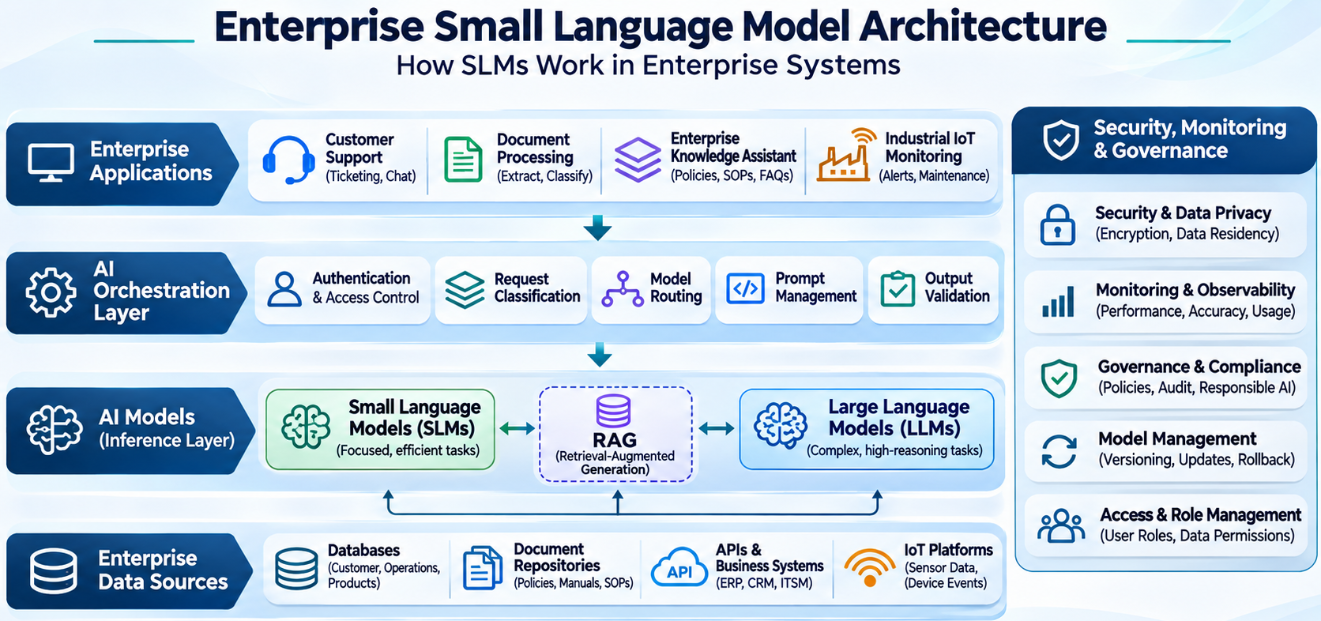
How Small Language Models Work in Enterprise Architecture
A Small Language Model is rarely a complete enterprise AI solution by itself.
Production applications usually combine the model with data retrieval, business rules, authentication, monitoring, and application interfaces.
A practical architecture separates these responsibilities.
Application Layer
Users interact with the AI system through applications such as:
- Enterprise web portals.
- Mobile applications.
- Customer support systems.
- Industrial monitoring dashboards.
- Internal knowledge assistants.
- Business workflow applications.
The application captures a request and forwards it to an AI processing service.
AI Orchestration Layer
The orchestration layer determines how the request should be handled.
Its responsibilities may include:
- User authentication.
- Request classification.
- Model selection.
- Prompt construction.
- Retrieval of relevant documents.
- Output validation.
- Audit logging.
For example, a request to classify a support ticket may be routed to a Small Language Model.
A complex request involving multiple documents and detailed reasoning may be routed to a more capable model.
This approach is known as AI Model Routing.
Small Language Model Inference Layer
The inference layer runs the selected model.
Depending on deployment requirements, the model may operate on:
- A local enterprise server.
- A private cloud.
- A public cloud instance.
- An industrial edge gateway.
- A capable workstation.
- An embedded Linux computer with sufficient resources.
The model receives an instruction and relevant context, then produces a response.
Enterprise Data Integration
Most enterprise applications require access to current organizational information.
A language model's training data does not automatically contain updated company policies, maintenance records, or customer documentation.
One common solution is Retrieval-Augmented Generation (RAG).
RAG retrieves relevant information from approved sources and provides it to the model as context.
For example:
An employee asks:
"What is the procedure for replacing a failed industrial gateway?"
The system searches approved maintenance documents, retrieves relevant instructions, and asks the model to generate an answer grounded in those documents.
The response can include references to the original material.
This approach reduces reliance on the model's internal knowledge, although it does not eliminate hallucinations.
Monitoring and Governance
Enterprise deployments require continuous monitoring.
Important measurements include:
- Response accuracy.
- Request latency.
- Model availability.
- Infrastructure utilization.
- Retrieval quality.
- Security events.
- Cost per completed task.
These measurements help determine whether the Small Language Model remains suitable as workloads evolve.
A Practical Enterprise Architecture
User Application → API Gateway → AI Orchestration → Model Selection → SLM Inference → Validated Response
Supporting services include:
Enterprise Documents → Retrieval System → Context Preparation
And:
Authentication + Logging + Monitoring + Security Controls
The architecture allows organizations to replace or upgrade models without rebuilding every application component.
Building an Enterprise SLM Architecture
Organizations evaluating Small Language Models should begin with a clearly defined workload rather than selecting a model first.
At Infolitz Software Pvt. Ltd., our engineering capabilities across Data/AI, Cloud/DevOps, Mobile Applications, and IoT & Embedded Systems support the development of integrated AI solutions.
If you are evaluating where smaller AI models could fit into your existing technology environment, contact Infolitz to discuss your architecture and deployment requirements.
Where Should Enterprises Use Small Language Models?
The most important enterprise AI decision is identifying workloads where a smaller model can achieve acceptable performance.
Not every application requires advanced general-purpose reasoning.
Several business processes benefit from speed, consistency, and constrained outputs.
Customer Support Ticket Classification
Customer support teams frequently receive large volumes of requests.
Many involve straightforward tasks such as identifying the issue category, extracting product information, or assigning priority.
A Small Language Model can analyze incoming messages and produce structured classifications.
For example:
Incoming request:
"Our gateway stopped reporting sensor readings after yesterday's firmware update."
Expected output:
- Category: Device connectivity.
- Product: IoT gateway.
- Possible trigger: Firmware update.
- Priority: Based on predefined business rules.
- Recommended team: Technical support.
The model assists classification, while business rules determine escalation and priority.
Best fit: High-volume support operations with well-defined categories.
Enterprise Document Processing
Organizations process invoices, contracts, purchase orders, technical reports, and operational documents.
Many workflows require extracting specific information rather than generating complex analysis.
Small Language Models can help identify:
- Invoice numbers.
- Contract dates.
- Customer references.
- Equipment identifiers.
- Maintenance actions.
- Compliance-related statements.
For example, a procurement application may extract supplier information from incoming purchase orders and prepare structured records for review.
Document extraction should still include validation rules and human review where errors could create financial or legal consequences.
Best fit: Repetitive document-processing workflows with structured outputs.
Internal Knowledge Assistants
Employees often spend time searching internal documentation.
A Small Language Model combined with RAG can provide a conversational interface to approved company information.
Potential applications include:
- HR policy assistants.
- IT troubleshooting guides.
- Engineering knowledge bases.
- Standard operating procedure searches.
- Internal product documentation.
The model does not need to know everything.
It needs to interpret the user's question, retrieve relevant information, and present an accurate response.
Best fit: Organizations with well-maintained documentation and narrowly defined knowledge domains.
Software Development Assistance
Small Language Models can support focused development activities.
Examples include:
- Code explanation.
- Documentation generation.
- Test case suggestions.
- Log interpretation.
- Simple code transformations.
- Configuration file analysis.
However, complex software architecture, security-sensitive code generation, and large repository analysis may require stronger models or specialized tooling.
Enterprises should evaluate generated code through testing, code review, and security checks.
Best fit: Narrow development tasks with automated validation.
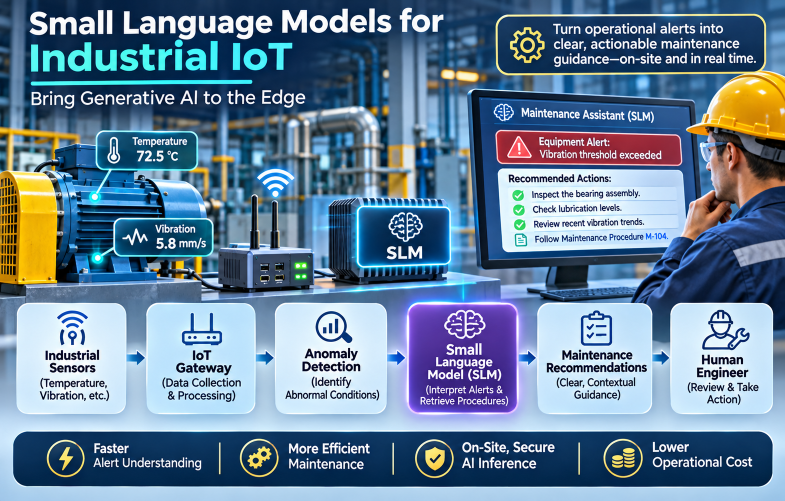
Industrial IoT Monitoring
Industrial IoT systems generate continuous streams of operational information.
Traditional monitoring systems already use rules, statistical methods, and machine learning to detect abnormal behavior.
Small Language Models can complement these systems by interpreting alerts and explaining operational conditions.
Consider an industrial gateway monitoring temperature, vibration, and equipment status.
A conventional anomaly detection system identifies an abnormal vibration pattern.
A Small Language Model receives the alert, equipment metadata, and relevant maintenance instructions.
It generates a readable explanation:
"Vibration levels have exceeded the configured operating threshold. Review the bearing inspection procedure and verify the sensor reading before scheduling maintenance."
The model does not need to perform the underlying signal processing.
Its role is to interpret structured information and assist operational decision-making.
Best fit: Industrial monitoring systems requiring local alert interpretation and maintenance guidance.
Edge AI for Connected Devices
Some connected products operate in environments where cloud connectivity is limited.
Examples include:
- Remote agricultural installations.
- Industrial equipment.
- Transportation systems.
- Energy infrastructure.
- Smart buildings.
A compact language model running on a capable edge computer may provide local command interpretation, troubleshooting assistance, or structured reporting.
However, most resource-constrained microcontrollers cannot run billion-parameter language models efficiently.
These devices are generally better suited to rules, TinyML, or compact task-specific models.
Best fit: Edge gateways and embedded computers with sufficient memory and processing capacity.
Enterprise Workflow Automation
Business workflows often involve reading messages, extracting information, and selecting the next action.
A Small Language Model can help interpret natural language and generate structured instructions.
For example:
An employee requests:
"Create a maintenance ticket for the temperature sensor in Building B."
The model extracts the equipment type, location, and requested action.
A workflow engine then validates permissions and creates the ticket through an approved API.
The model interprets the request, while deterministic software executes the action.
This separation reduces the risk of unauthorized or incorrect operations.
Best fit: Workflow automation with controlled actions and clearly defined permissions.
Tools and Technology Stack Options
Several model families and inference frameworks support Small Language Model deployments.
The appropriate choice depends on licensing, hardware, accuracy, language support, and integration requirements.
Microsoft Phi
The Phi family includes compact language models designed for efficient language and reasoning tasks.
Different releases support different capabilities and deployment configurations.
Phi models may be useful for enterprise applications that require smaller model footprints.
Organizations should evaluate the exact model version and its licensing terms before deployment.
Official reference: Microsoft Phi models
Google Gemma
Gemma is a family of open-weight models available in multiple sizes.
Smaller variants can support local inference and specialized applications.
Gemma models can be evaluated for document processing, application assistance, and other language-based workloads.
Official reference: Google Gemma
Meta Llama
The Llama family includes models with different parameter counts and capabilities.
Smaller variants can be considered for enterprise applications requiring self-hosted inference.
Deployment decisions should account for the applicable model license, hardware requirements, and operational constraints.
Official reference: Meta Llama
Qwen
Qwen provides models across several sizes and capabilities, including compact models suitable for local experimentation and deployment.
Depending on the model, potential applications include multilingual processing, structured extraction, and coding assistance.
Official reference: Qwen
Common Inference Frameworks
Ollama
Ollama simplifies running supported models locally.
It is useful for prototyping, developer testing, and smaller deployments.
Official reference: Ollama
llama.cpp
llama.cpp supports efficient inference for compatible models across different hardware platforms.
It is particularly relevant when evaluating quantized models and CPU-based execution.
Official reference: llama.cpp
vLLM
vLLM is an inference-serving framework designed for efficient language model execution.
It can be useful for server-based deployments requiring concurrent requests and optimized throughput.
Official reference: vLLM
How Should Enterprises Select a Model?
A practical evaluation should consider five questions.
First: Does the model achieve acceptable accuracy on real business examples?
Second: Can it run on the available infrastructure?
Third: Does its license permit the intended commercial deployment?
Fourth: Can it meet response-time and concurrency requirements?
Fifth: Can the organization monitor, secure, and maintain the deployment?
Model popularity should not determine enterprise architecture.
A smaller model that reliably completes a narrow task may provide greater value than a more capable model that introduces unnecessary cost.
Best Practices for Enterprise Small Language Model Deployment
Successful SLM adoption requires more than downloading a model and connecting it to an application.
Organizations should treat deployment as an engineering process.
Start With a Narrow Use Case
Choose a workload with measurable outputs.
Examples include ticket classification, document extraction, or internal knowledge retrieval.
Avoid beginning with a broad objective such as building an AI assistant capable of handling every enterprise task.
Narrow applications are easier to evaluate, secure, and improve.
Build an Evaluation Dataset
Collect representative examples from the intended workload.
For a support classification application, the dataset should include common issues, ambiguous requests, unusual terminology, and difficult cases.
Separate development examples from evaluation examples to reduce the risk of overestimating performance.
Establish Acceptance Criteria
Define success before selecting the model.
For example, an organization might establish the following pilot targets:
- Classification accuracy of at least 95% on an agreed test dataset.
- A 95th-percentile response time below two seconds.
- No unauthorized access to restricted documents.
- Structured output validation for every automated action.
- Human review for low-confidence or high-impact decisions.
These are illustrative acceptance criteria, not universal SLM performance benchmarks.
Actual thresholds should reflect business risk and operating conditions.
Use Retrieval Before Fine-Tuning
Fine-tuning is not always necessary.
If the main challenge is accessing current company information, RAG may be the better starting point.
Fine-tuning becomes more relevant when the model needs consistent domain-specific behavior, terminology, or output formatting.
Separate AI Decisions From Business Actions
Language models can generate incorrect or unexpected outputs.
Applications should validate model responses before executing sensitive operations.
For example, an AI model may identify a maintenance request, but a workflow engine should verify authorization before changing equipment configuration.
Monitor Production Performance
Model quality can decline when input patterns, documentation, or business processes change.
Continuous evaluation should include representative production examples, operational metrics, and periodic human review.
Common Pitfalls
Choosing the smallest model without testing: Lower infrastructure costs are irrelevant if accuracy is insufficient.
Ignoring prompt length: Long prompts increase processing time and memory requirements.
Assuming local deployment guarantees privacy: Internal systems still require security controls.
Using language models for deterministic tasks: Rules and conventional software are often more reliable for fixed calculations and predefined logic.
Skipping fallback mechanisms: Some requests will exceed the capabilities of the selected SLM.
Failing to account for maintenance: Models, dependencies, infrastructure, and security controls require ongoing updates.
Performance, Cost, and Security Considerations
The financial case for Small Language Models depends on the complete operating environment.
Understanding Inference Costs
Cloud-hosted AI systems may charge per input and output token.
Self-hosted models introduce infrastructure and operational expenses.
A simplified monthly cost model is:
Total Monthly Cost = Infrastructure + Operations + Maintenance + Supporting Services
Cost per successful task can then be calculated as:
Cost per Successful Task = Total Monthly Cost ÷ Successfully Completed Tasks
This metric is often more useful than cost per token.
A low-cost model that frequently produces incorrect results may require additional processing, retries, or human intervention.
Hardware Requirements
Model memory consumption depends on parameter count and numerical precision.
For illustration, consider a 7-billion-parameter model.
At 16-bit precision, raw model weights require approximately 14 GB.
At 8-bit precision, raw weights require approximately 7 GB.
At 4-bit precision, raw weights require approximately 3.5 GB.
These estimates exclude additional runtime memory.
Actual requirements vary with model architecture, quantization method, context length, inference engine, and concurrency.
Latency and Throughput
Two important performance metrics are latency and throughput.
Latency measures how long a request takes to complete.
Throughput measures how much work the system processes over time.
A deployment optimized for one interactive user may behave differently when serving hundreds of concurrent requests.
Enterprises should benchmark both conditions.
Security and Data Governance
Small Language Models introduce familiar application security requirements alongside AI-specific risks.
Important controls include:
- Authentication and authorization.
- Encryption in transit and at rest.
- Role-based access to enterprise documents.
- Prompt injection defenses.
- Output validation.
- Secure model artifact management.
- Audit logging.
- Dependency and vulnerability monitoring.
RAG applications require particular attention to document permissions.
A retrieval system must not expose information merely because it is available in a shared index.
The user's access rights should determine which documents can be retrieved.
Model Licensing
Open-weight models are not necessarily open-source software.
Licenses may impose restrictions on commercial use, redistribution, acceptable use, or other activities.
Organizations should review the specific license associated with the model version they intend to deploy.
Evaluating the Business Case
A Small Language Model is economically attractive when it completes a meaningful percentage of requests accurately while reducing the total cost of service.
The comparison should include operational effort, infrastructure utilization, fallback requests, and human review.
From Experimentation to Production
A working SLM demonstration does not automatically become a reliable enterprise application.
Production systems require secure integration, deployment automation, monitoring, testing, and ongoing operational ownership.
Infolitz supports organizations across AI application development, cloud infrastructure, embedded systems, and enterprise integration.
For businesses planning to move from AI experimentation to production deployment, contact Infolitz to discuss the technical requirements and implementation approach.
Small Language Models vs Large Language Models
Small and Large Language Models serve overlapping but different requirements.
Small Language Models
Small Language Models are often attractive when applications require:
- Lower memory consumption.
- Local deployment.
- High-volume repetitive processing.
- Narrow-domain specialization.
- Reduced infrastructure requirements.
- Greater control over inference environments.
Their limitations may include weaker performance on complex reasoning, broad knowledge tasks, and difficult multi-step instructions.
Large Language Models
Large Language Models are often preferable for:
- Complex reasoning.
- Broad research assistance.
- Advanced code generation.
- Multi-document synthesis.
- Open-ended conversational applications.
- Tasks requiring stronger general-purpose capabilities.
However, larger models may introduce higher infrastructure requirements, increased operating costs, and additional deployment complexity.
Why Hybrid AI Architectures Make Sense
Enterprises do not need to select one model for every workload.
A hybrid architecture can route requests according to complexity.
For example:
Request 1: Classify an incoming support ticket.
Route to a Small Language Model.
Request 2: Extract equipment identifiers from a maintenance report.
Route to a Small Language Model.
Request 3: Analyze a complicated engineering failure involving multiple technical documents.
Route to a more capable model.
Request 4: Generate a simple structured response from approved operational data.
Route to a Small Language Model.
This architecture allows organizations to reserve expensive model capabilities for tasks that genuinely require them.
However, routing introduces additional complexity.
The system must classify requests accurately, manage multiple model endpoints, and monitor whether routing decisions improve overall results.
The correct architecture is the simplest one that meets performance, cost, and reliability requirements.
Real-World Application Scenario: Small Language Models in Industrial IoT
Consider a manufacturing company operating hundreds of connected machines across multiple facilities.
Its monitoring platform collects equipment temperature, vibration, operating status, and diagnostic information.
Traditional monitoring software identifies abnormal conditions and generates alerts.
However, maintenance engineers must interpret technical codes, consult documentation, and determine appropriate next steps.
This creates an opportunity for a Small Language Model.
Before: Alerts Without Context
An engineer receives a notification:
"Machine 24: Vibration threshold exceeded."
The engineer must manually check equipment documentation, review recent events, and identify possible maintenance procedures.
The monitoring system detects the problem but provides limited assistance in interpreting it.
The Proposed Solution
A Small Language Model is deployed on an industrial edge server or within the organization's private infrastructure.
The application integrates with:
- The existing IoT monitoring platform.
- Equipment metadata.
- Maintenance documentation.
- Historical incident records.
- Approved troubleshooting procedures.
When an alert occurs, the application retrieves relevant operational context.
The Small Language Model then generates a structured explanation.
For example:
"Machine 24 has exceeded its configured vibration threshold. Review the latest sensor readings, inspect the bearing assembly according to the approved maintenance procedure, and verify whether similar alerts occurred recently."
The response includes references to the relevant maintenance instructions.
After: Contextual Operational Assistance
Engineers receive alerts accompanied by relevant documentation and suggested investigation steps.
The system may reduce the time spent searching for information.
However, the actual benefit must be measured through a controlled pilot.
Useful evaluation metrics include:
Time to understand an alert: Compare average investigation time before and after deployment.
Recommendation accuracy: Measure how frequently generated guidance matches approved maintenance procedures.
Engineer acceptance: Track whether maintenance personnel find the recommendations useful.
Inference cost: Measure infrastructure and processing costs per completed request.
System availability: Confirm that the solution remains operational under expected network and hardware conditions.
This scenario illustrates a potential architecture rather than a documented customer deployment or verified performance result.
Important Engineering Boundary
The language model should not replace deterministic safety controls.
Industrial protection systems, emergency shutdowns, and critical equipment commands should remain under appropriately engineered control systems.
The SLM provides information and assistance, not unrestricted operational authority.
Where IoT and Generative AI Converge
Industrial IoT platforms already generate valuable operational data.
Small Language Models can help translate that data into explanations, documentation searches, and workflow assistance.
The opportunity is not to replace conventional monitoring algorithms.
It is to make existing operational information easier for people to understand and act upon.
How to Decide Whether an Enterprise Workload Needs an SLM
Organizations can use a practical evaluation process before committing to deployment.
Step 1: Identify the Business Task
Define the exact operation the AI system must perform.
Avoid broad requirements such as "automate customer support."
Instead, specify:
"Classify incoming support tickets into ten predefined categories and extract the affected product identifier."
Step 2: Establish a Baseline
Measure the existing process.
Relevant metrics may include processing time, accuracy, manual effort, and cost per completed task.
Without a baseline, it becomes difficult to demonstrate improvement.
Step 3: Test Multiple Approaches
Evaluate a rules-based system, a suitable Small Language Model, and a more capable model where appropriate.
Some workloads may not require generative AI at all.
Step 4: Evaluate Quality and Reliability
Test representative requests, including difficult and ambiguous examples.
Measure accuracy, latency, failure rates, and the frequency of human intervention.
Step 5: Calculate Total Operating Cost
Include infrastructure, engineering, maintenance, monitoring, and fallback processing.
Avoid evaluating models using token pricing alone.
Step 6: Review Security Requirements
Identify sensitive data, user permissions, compliance obligations, and deployment restrictions.
Determine whether local inference is necessary or whether a managed service meets the requirements.
Step 7: Conduct a Controlled Pilot
Deploy the selected approach to a limited workload.
Compare results against the original baseline.
Expand only when the evidence supports broader adoption.
This process reduces the risk of choosing technology based on model popularity rather than measurable business value.
FAQs
What are Small Language Models?
Small Language Models are AI models designed to process and generate language using relatively fewer parameters and computational resources than many larger models. They are useful for focused tasks such as classification, information extraction, and domain-specific assistance.
Are Small Language Models suitable for enterprise applications?
Yes. Small Language Models can support enterprise applications when their accuracy, reliability, security, and performance meet the workload's requirements. They are particularly relevant for narrow, repetitive tasks and controlled deployment environments.
Can Small Language Models replace Large Language Models?
Not completely. Small Language Models can replace larger models for some well-defined tasks, but complex reasoning and broad knowledge applications may still benefit from more capable models. Many enterprises can use both through hybrid AI architectures.
Can Small Language Models run without internet access?
Yes. Compatible models can operate locally without continuous internet connectivity when the required model files, software, and computing resources are available. External integrations may still require network access.
How much does it cost to deploy a Small Language Model?
Deployment costs depend on model size, hardware, request volume, concurrency, engineering effort, and operational requirements. Self-hosting may reduce variable inference expenses, but infrastructure and maintenance costs must also be considered.
Are Small Language Models secure?
Small Language Models can be deployed within controlled enterprise environments, which may improve data governance. However, security still depends on authentication, authorization, encryption, infrastructure protection, and safe integration practices.
Can Small Language Models be used in IoT devices?
Yes, but hardware capabilities matter. Billion-parameter language models generally require more resources than typical microcontrollers provide. Capable edge computers and industrial gateways are more practical deployment targets.
What is the difference between Small Language Models and TinyML?
TinyML typically refers to machine learning models designed for highly constrained devices such as microcontrollers. Small Language Models focus on language understanding and generation and generally require substantially more memory and computing resources.
Should enterprises fine-tune Small Language Models?
Fine-tuning may help when applications require specialized terminology, consistent behavior, or task-specific outputs. However, organizations should first evaluate prompting and retrieval-based approaches because they may achieve the required results with less training effort.
What are the best Small Language Models for enterprises?
There is no single best model for every enterprise. Suitable candidates may come from families such as Phi, Gemma, Llama, and Qwen. The best choice depends on workload accuracy, licensing, hardware compatibility, latency, security, and total cost.
The future of enterprise AI is not about using the biggest model for every problem. It is about deploying the right intelligence, in the right place, at the right cost.

Conclusion
Small Language Models are becoming valuable components of enterprise AI architecture, particularly for focused tasks, private deployments, and edge applications. Their value depends on measurable performance rather than model size alone.
Organizations that evaluate accuracy, infrastructure requirements, security, and total operating cost can make better decisions about where smaller models belong.
Exploring Small Language Models for your enterprise applications, IoT platform, or AI infrastructure? Contact Infolitz Software Pvt. Ltd. to discuss a practical implementation approach.


